ReUp Learner App
ReUp Education partners with higher ed institutions and state education departments in the U.S. to help adult stop-outs with some college, no degree (SCND) return to school and earn their credentials.
Role: Lead UX Researcher & Strategist | Collaborators: Product Managers & Designers
Outcome: Launched a meaningful core user experience and helped scale coaching services, resulting in $2M annual recurring revenue
Project Overview
For adult stop-outs, the process of returning to school years later is often complex and demotivating. These individuals (referred to as learners) stop out for a myriad of reasons — like the high cost of education, needing to work, and fulfilling family commitments. ReUp serves this unique population of prospective students by partnering with higher ed institutions to improve policy making and offering free, direct coaching to learners.
Each learner is at a different stage of returning to college. While they all have access to 1:1 coaching services, the majority of learners interact primarily with ReUp’s digital marketing resources. As ReUp began to expand its partnerships with states and schools in 2023, the “ReUp Learner App” was created to serve stopped-out learners at scale.
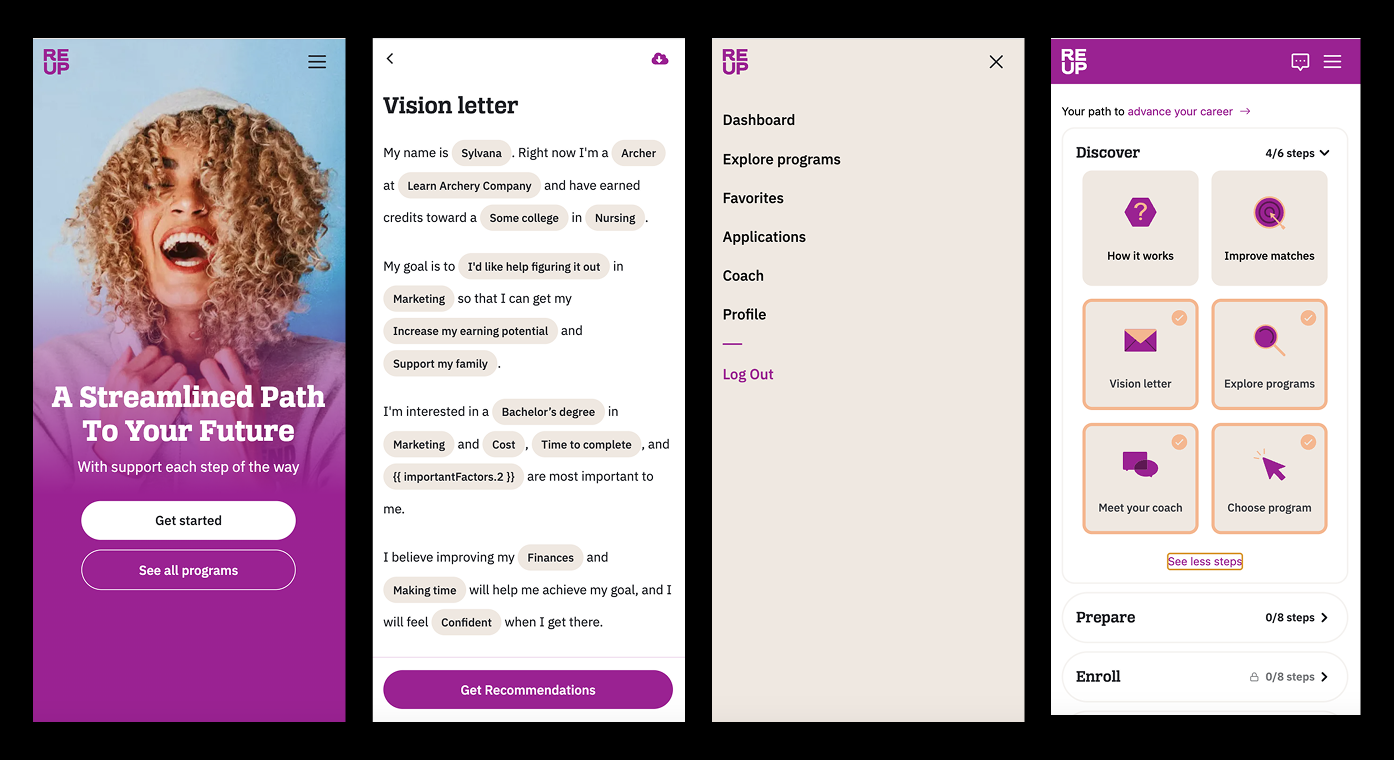
The alpha version of the Learner App included a landing page, onboarding questions, a “vision letter” and a basic dashboard. (image right)
Research Objectives
Understand what motivates adult learners to take the next step in their educational journey
Understand how much information users are willing to provide
Understand where users need the most help in the process of returning to school
Some College, No Degree
I recruited 7 existing ReUp learners at different stages of their educational journey and across various demographics, including those who previously engaged with a coach and those who did not.
To reach a sufficient sample size, I sourced 6 additional panel participants through Userlytics that matched the target user base: those with “some college, no degree” who were not currently enrolled in credit classes.
Methodology
I conducted usability testing with participants via Zoom to observe how they reacted to the live app experience. Testing was integrated with interview questions to understand their motivations on a deeper level. This combination proved effective as some participants were not as tech savvy as others.
Qualitative insights helped define requirements for the MVP, eventually leading to the app’s initial launch and adoption by first-time users. These insights also informed the development of future product features.
“Somebody wants to help me with my future…probably one of those people who wants me to invest money. I would leave. There’s nothing telling me what this is.”
Findings
Users were skeptical towards the product but open to receiving personalized help. The app experience assumed that users were already familiar with ReUp and their relationship with their previous school. In reality, even those who worked with a ReUp coach needed a stronger throughline.
Additionally, a lengthy onboarding process (24 questions!) signaled to users that their information would be used for personalized guidance and app customization. At the same time, some questions felt useless or redundant.
Connecting with a coach remained the #1 value proposition while the “vision letter,” a Mad Libs-esque summary of their inputs, came off as corporate and alienating. This emphasized the need for a more direct, approachable experience.
Unmoderated users were led astray by links in the footer and ended up on the ReUp.com marketing website, which was not connected to the product page.
Recommendations
As a result of these findings, I recommended reframing the landing experience around trust, transparency, and clarity of purpose. This directly informed the decision to:
Refresh the landing page prior to launch
Remove the “vision letter” and authentication requirements, leading to faster TTV
Conduct a future audit of user onboarding
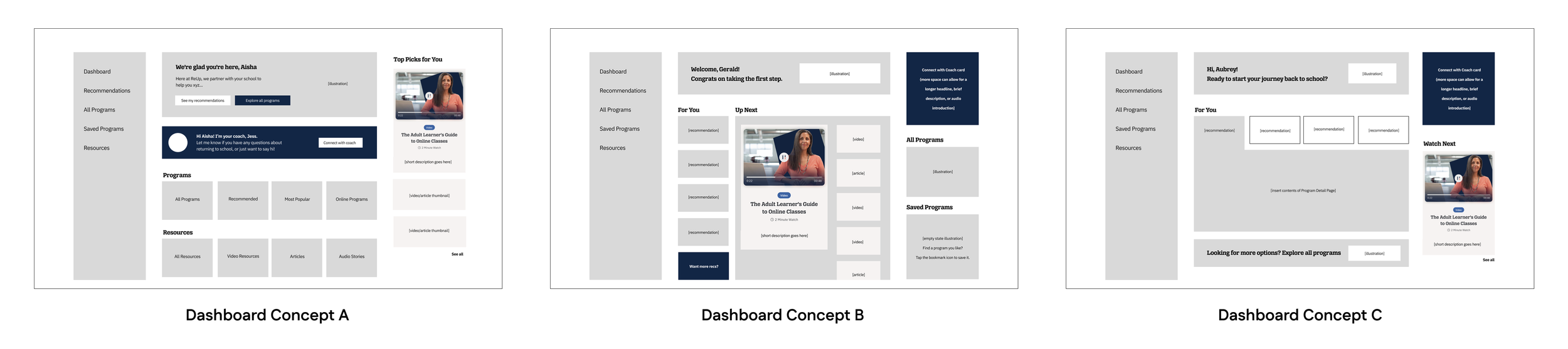
After conducting follow-up research, I also proposed a new dashboard concept with tasks and coach-focused features that became the basis of the app’s current design. (see below)
Research Impact
After refreshing the landing page and removing the “vision letter” and authentication, our team was able to provide a more meaningful core interaction for users. In September 2023, the product team launched a simplified version of the app — focused on program recommendations — with the New Jersey Office of the Secretary of Higher Education.
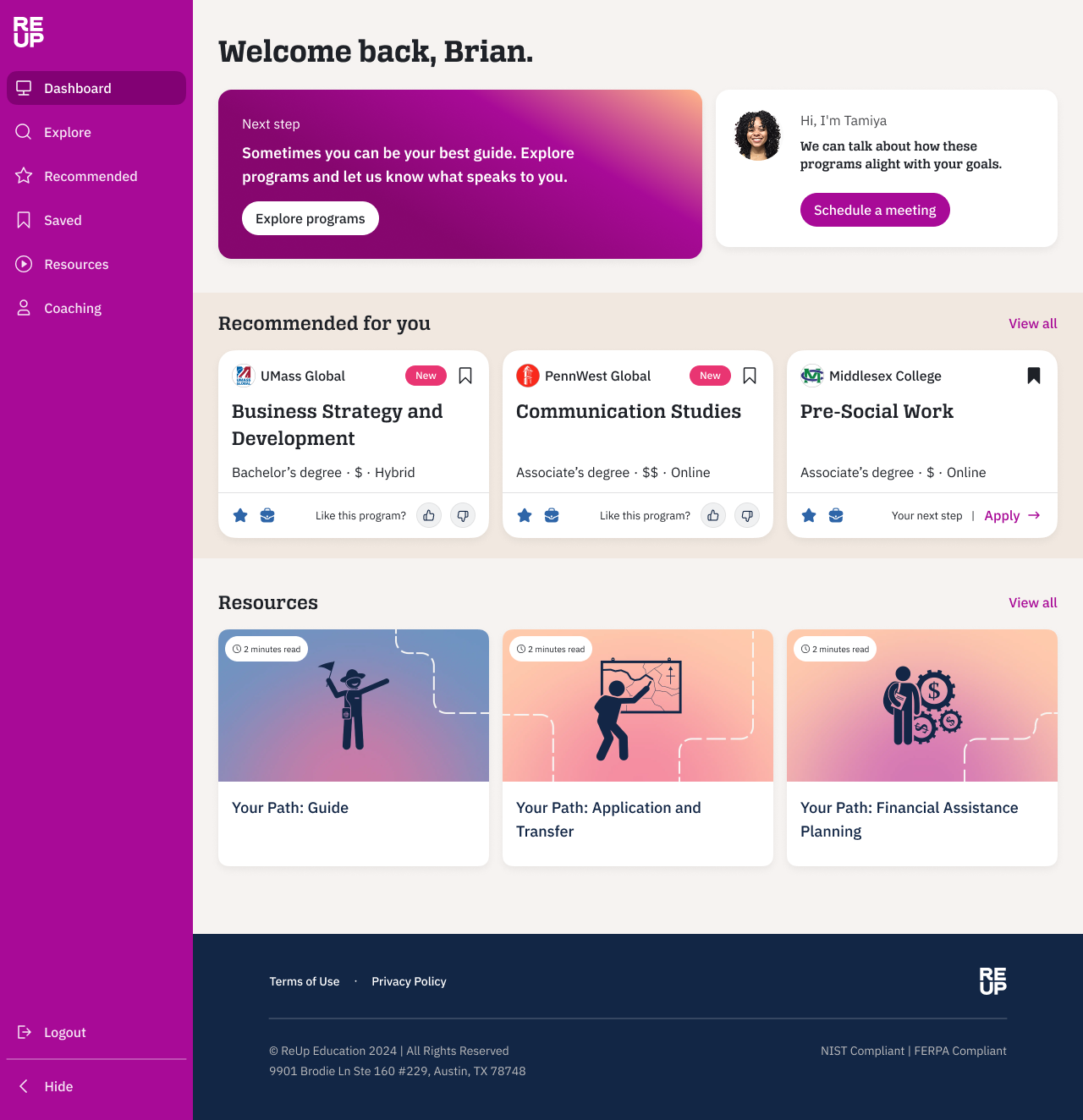
The current version of the app features next steps for prospective students, recommended programs, resources, and the ability to connect with a coach.
Two years later, the ReUp Learner App generated $2 million in annual recurring revenue (ARR) across multiple partnerships and reduced operational overhead by $450K annually. It continues to help prospective students compare programs they’re interested in, offers personalized recommendations, and provides interactive resources to help them overcome common barriers to re-enrollment.
As a result, learners continue to re-enroll at the same rates with less coaching support, and coaches are able to focus on those who need the most help.